

Why the Apple Watch will never cannibalize iPhone sales
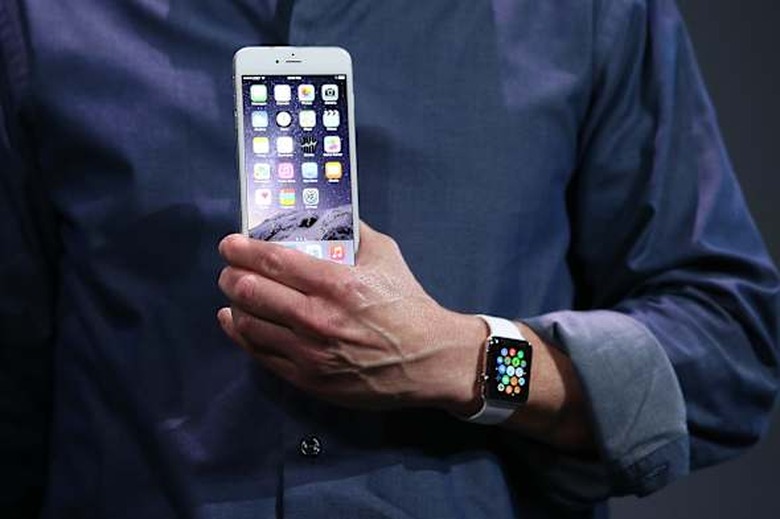
Recently, some smart industry observers have discussed the idea that the Apple Watch will one day feature cellular connectivity and actually become so compelling as to cannibalize iPhone sales.
The always insightful Ben Thompson of Stratechery, in writing about the impetus behind Apple releasing the Apple Watch in 2015, discussed the device's potential to be "Digital Hub 3.0." and an heir to the iPhone throne.
I believe that in the long run – i.e. not this version of the Apple Watch, but the one several iterations down the line – the Watch will have cellular capability and the ability to interface with any number of objects, including accessories that have larger screens and/or superior input methods,1 and will be the center of your computing existence. From Apple's perspective, that means the Watch category is the very long-term replacement for the iPhone, at least for some segment of the population. Again, I'm not talking about 2015 or probably anytime in the next five years, but rather the very long term.
...
Then, over many years, I believe we will use and carry our smartphones less and less even as they become bigger and more capable (in this regard, the iPhone Plus may have the additional moniker, but I believe it's the true future iPhone) because we will have an even more portable and personal device with us all of the time. And, in true Apple fashion, they will be ok with that, because we will be replacing their central product with another one from Apple that is potentially even more lucrative.
It's an interesting premise, and one echoed by John Gruber of Daring Fireball who wrote the following last week:
Modern Apple has never been afraid to release products that cannibalize their own products.
...
A few years down the line, I expect Apple to have a Watch that can replace your iPhone. The tech just isn't there yet. Apple is already setting expectations for single-day battery life for the Apple Watch, at best.
Even the well-sourced Amir Efrati from The Information believes this to be Apple's aim.
Saying Apple wouldn't cannibalize iPhone w/ Apple Watch + SIM now and believing eventually it will (I do) isn't mutually exclusive. @gruber
- Amir Efrati (@amir) September 25, 2014
To which Gruber responded:
@amir I think if they could do it today — battery-wise, size-wise — they would.
- John Gruber (@gruber) September 25, 2014
Though an admittedly interesting premise, the notion that the Apple Watch will, one day, serve as a worthy replacement for the iPhone on such a scale that one might someday proclaim that it's eating into iPhone sales is patently absurd. The Apple Watch may very well prove to be a huge money maker but an iPhone replacement it is not, nor will it ever be.
Gruber is correct in stating that Apple has never been afraid to release products that cannibalize their own. On the contrary, and as Apple executives themselves have stated, they prefer it. After all, if one company is going to put a dent into Apple product sales, they'd rather be the ones doing it.
The thing is, cannibalization occurs when a new device comes along that either a) houses more attractive or extensive features than an existing device or b) offers a similar set of features at a reduced price point. Recall that the iPhone cannibalized iPod sales because its functionality completely trumped anything the iPod was capable of.
The Apple Watch, even if it becomes an immensely popular digital hub with a thriving ecosystem of interesting apps, doesn't accomplish either. By virtue of its size alone, its utility as a hub for one's entire mobile computing experience is stunted from the start. If the Apple Watch proves successful, it will exist as a thriving product category that, if anything, will help spur iPhone sales rather than eat into them.
I do agree with Thompson's assertion that the Apple Watch will sometime down the road be able to interface with a wide array of objects. Indeed, Tim Cook overtly alluded to this functionality during a recent interview with BloombergBusinessweek:
And so it will operate your Apple TV, and you can imagine that it can control other things as well.
...
And because you're not searching for yet another object in your home to get to, this is an object that's attached to you. There's loads of things that you can do with it.
But the buck stops there. Toss in GPS, cellular connectivity or whatever else you want and the Apple Watch still is no iPhone replacement.
The idea that the Apple Watch could one day serve as a replacement for the iPhone completely ignores the manner in which millions of people use and interact with their mobile devices. People love the iPhone because it's quite literally a computer in your pocket. It's why talking on the phone is, according to one study, only the fifth most popular use for smartphones, ranked below time-honored traditions such as browsing the web, playing games, and texting. I fail to see how an Apple Watch, in any incarnation, would be able to provide a superior or even close-to-equivalent user experience for any number of popular iPhone uses.
Apple Watch is constrained by fashion
Now you might be wondering — what if the fourth-gen Apple Watch comes with GPS, a larger display, and hell, even a capable video camera? That scenario still fails to present a compelling case.
Apple understands that watches are as much about fashion as they are about utility. It's why Apple now has a few fashion executives under its employ, and more glaringly, why the Apple Watch, upon launch, will be available in a wide array of styles. At a certain point, adding all of these extra hardware-based bells and whistles and the Apple Watch quickly becomes too large and unwieldy. Because watches are, in this day and age, essentially pieces of jewelry, Apple is working under constrained conditions created not by technology, but by fashion.
On the flipside, even if Apple can magically cram a host of incredible new features into the Apple Watch and keep its form factor untouched, the screen remains far too small for most tasks.
Apple Watch functions best as an extension of other devices
This is precisely why the Apple Watch is being positioned as an extension for existing devices and not a replacement for any of them. Future use cases for the Apple Watch, even this early in the game, are compelling: making sure household lights are off, unlocking your door, quickly checking items like the weather and email, controlling your Apple TV, setting your DVR, heating up your car, engaging in a few short text message exchanges, viewing FaceBook notifications, perusing Twitter on the go. For these lightweight tasks, the Apple Watch will thrive, ensuring that control of this new "digital hub" will always be readily accessible. But the appeal of the iPhone for the vast, vast majority of users are the tasks which require heavy lifting — browsing FaceBook, recording HD video, taking stunning photos, streaming music, browsing the web, playing games, and oh yeah, making phone calls. For these primary use cases, the Apple Watch is hardly a compelling alternative.
The idea that the Apple Watch will one day cannibalize iPhone sales rests on the faulty assumption that the device will be able to fundamentally change entrenched consumer behavior patterns. It assumes that consumers will, at some point in the future, adjust their behavior to accommodate a watch that provides less functionality than an equally mobile, much larger, and markedly more feature rich iPhone.
Apple Watch can succeed as a standalone product in its own product category
Nonetheless, the Apple Watch as an iPhone extension, and even as a standalone accessory, may prove to be unbelievably successful as a product category unto itself. Down the line, one can reasonably expect the Apple Watch to add features such as GPS and, one can only imagine, additional health and fitness oriented sensors and functions. It'll also be interesting to see what developers are able to conjure up with WatchKit once they get their hands on it.
So rather than intruding upon iPhone sales, the Apple Watch may serve to increase iPhone sales as consumers look to unlock the Watch's full potential.
What's more, some have opined that the Apple Watch might work extremely well as a new take on the iPod. Rumor has it that the Apple Watch comes with at least 4GB of internal storage. Put it on your wrist, load some music onto it, slap on some wireless bluetooth headphones (Apple may have a few Beats models to offer you) and you're good to go. Toss GPS into the mix and the Apple Watch is all of a sudden an appealing all-in-one MP3 player/fitness tracker solution for runners.
But the iPhone itself, as a primary mobile device, isn't going anywhere. Not with Apple Watch version 1 and not with Apple Watch version 5. It's hard to imagine what in the world the Apple Watch could bring to the table to actually eat into iPhone sales, the inclusion of a cellular stack be damned.
I recently stumbled across a germane 2003 quote from Steve Jobs, said in response to a question asking why the iPod doesn't have Wi-Fi and is so dependent upon a computer to function:
Well it can, but a personal computer at its very basics has a really big hard drive in it, its got a really big display, its got a really big keyboard, and its got a really fat pipe to the internet. And its got a reasonable processor in it that can run really big applications. So, the iPod might be great and holds all our music, but we see it more as a satellite device because you couldn't [looks down at his hand like he's holding an iPod] really do a music store on it because the music store just needs more screen real estate and these things fight each other. So if you want a compact thing you can put in your pocket, unless their's a breakthrough in foldable displays over time, it's going to be hard to really browse a music store and find the music you want on the iPod itself even if it has an internet connection.
The Apple Watch, like the iPod before it, is a satellite device. It will undoubtedly evolve over time and when Apple Watch version 7 comes out, we'll certainly look back at the original and laugh at its limitations. The iPhone, though, isn't going anywhere.