

Microsoft Build 2026: Live updates on Project Solara, Copilot AI, Windows, agents and more
We're expecting CEO Satya Nadella's presentation to last two and a half hours and cover a lot of ground.
Developer conference season continues with Microsoft Build today, and we're expecting the company to share news about updates coming to Windows, Copilot and possibly even Office 365 products this afternoon. CEO Satya Nadella's keynote is expected to start at 12:30PM ET today (June 2) and run for a whopping two and a half hours.
Because the timing coincides with Computex, the PC industry's trade show that takes place annually in Taiwan, Microsoft has already unveiled a new Surface Laptop Ultra ahead of today's keynote. It's a 15-inch MacBook Pro lookalike with NVIDIA's RTX Spark system-on-chip providing serious graphics and AI processing.
The Build 2026 keynote started at 12:30PM ET, and it has already been fairly eventful. We learned about the company's new Project Solara, a platform for agent-first systems and features two concept devices. There have also been appearances by NVIDIA CEO Jensen Huang and Qualcomm's Cristiano Amon. Scroll right down for the latest!
142 Updates
-
Hi, folks. Igor Bonifacic, senior reporter, alongside senior editor Devindra Hardawar here to live blog Build 2026.
-
In the spirit of former Microsoft CEO Steve Ballmer, I ask you to chant "Developers! Developers! Developers!" anytime there's mention of Copilot or AI.
-
Dev, what are you expecting out of Microsoft today? It seems like the company announced anything hardware-related it had to share during the weekend Computex flood.
-
As a reminder for everyone, Satya Nadella's keynote starts at 12:30PM ET, with Microsoft scheduling two-and-a-half hours for the full presentation, so be sure to get plenty of snacks and refreshments if you plan to join us for the entire event.
-
Good morning everyone! And I think we all know what to expect Igor: Everything AI! Build is a typically dry developer conference, with none of the showmanship of Google I/O or Apple's WWDC.
That's why we got the major consumer news earlier: The Surface Laptop Ultra, powered by NVIDIA's RTX Spark chip. What's surprising is that we actually won't see that computer until this fall, and we have no idea what it'll cost yet.
-
Yeah, I imagine no company wants to announce pricing when the great RAMageddon will make them just look like fools in a few months time.
-
And to be clear folks, both Igor and I are covering the Build keynote remotely. I would have loved to make it out to SF, but not sure it would have been worth it news-wise. Also, sometimes you just need to shut your eyes a bit during a Build keynote...
-
While we wait, any highlights from Computex? Do you think the new XPS 13 will offer a good experience with just 8GB of RAM?
-
LOL no. I feel bad that Dell and Acer are trying to make 8GB systems work, knowing what Windows will do to them. There's potential for a really minimal Arm-based Windows system to do well with 8GB though. And I think Microsoft has really gotten the message with the MacBook Neo: Cheap PCs can't be good because of Windows.
-
And I say this as someone who mostly writes, games and podcasts from Windows 11! A lot of people thought I was some sort of Apple fanboy on the Surface Laptop Ultra post, please check yourselves folks. I was born in Windows, raised on blue screens ;)
-
Right, I wonder if we may get some announcements around that issue.
-
If I had to guess about one topic, I think we'll definitely hear a lot about AI agents in Windows. they've become really popular over last year, but the most interesting ones are complex and require command line knowledge. Microsoft wanted to do something similar with Copilot, but the branding around everything Copilot has been so bad, they may need to call it something else.
-
That's a good guess. Google had quite a lot to say about agents at I/O a few weeks back. That said, I do wonder if Microsoft has so bungled everything around Copilot that it will make any AI subsequent push difficult.
-
To its credit, MS has done a good job with Github Copilot, which launched well before the more consumer AI dreck. Microsoft claims it genuinely helps developers, and I've heard that from a few programmers as well. Maybe these AI tools are better suited to the people making software, instead of using them.
-
We're a few minutes away from the Build keynote folks, sit tight! And seriously, get some caffeine.
-
And here we go!
-
Cue generic hype video with Windows 95 boot up song!
-

-
Microsoft CEO Satya Nadella has hit the stage. He says developer conferences are often about coming to grips with new opportunity. "And if there's one key takeaway, it would be this: How do you all participate fully in this frontier development ecosystem?"
-
He's talking about the tech stack that's typically involved with building software. He kicks things off by discussing infrastructure, and we're headed straight to a chat about Windows. "Unmetered intelligence in every desk in every home," says an on stage slide.
-
Nadella announces two new edge models that developers that can run on their own machines.
-
Nadella says Microsoft is expanding more Windows AI development APIs to more PCs. And things are going to get very complex now...
-
He's talking about the new Surface Laptop Ultra, which is powered by NVIDIA's RTX Spark AI chip. As powerful as this thing is, it also looks surprisingly basic. No curved edges! Just a simple laptop.
-

Here's Nadella just moments before announcing the Surface RTX Spark Dev Box.
-

It looks very small. Almost like an Xbox Series S.
-

Here's a better view of the new machine. Nadella says developers can join the waitlist today, and jokes he's already on it.
-

Nadella shares a look at the new GitHub Copilot-powered terminal tool.
-
Build once again has the crown for live dev environments on stage.
-
Why are we starting this segment of the presentation talking about the placement of the taskbar? Well, if you recall after Microsoft promised to fix Windows 11, it said one of its first priorities was to allow users to move the taskbar again.
-
It seems silly, but it's a small thing Microsoft can do to appease its users. One of the big issues with Windows 11 was that it was needlessly restrictive just for aesthetic reasons.
-
I know this makes for a flashy demo, but I can't see many devs using Copilot to issue command prompts with their voice.
-
I don't want to know how much this machine will cost if it has more than 90GB of VRAM available to it, and what it will do to consumer GPU pricing as a result. 🥲
-
Hah, I was thinking the same thing Igor. Will these folks really want a $5,000 Surface Laptop?
-
Nadella is now talking about getting permission from local communities to build data centers, which is not something Sundar Pichai did during Google I/O.
-
Nadella is talking about the commitment Microsoft has to local communities where it's building AI datacenters. That includes making sure power prices don't go up, keeping water usage in check and trying to offer local jobs. That all sounds nice, but historically all of these datacenter have been damaging to their communities.
-
But good point Igor, Google didn't touch on this at all.
-
Nadella says Microsoft has built more Azure infrastructure in the past 18 months than it did in the first decade of offering the cloud compute platform.
-
Gulp.
-

Here's Nadella talking about some of the innovations Microsoft has deployed to reduce data center water usage.
-
In the past, I've often accused Nadella of using a lot of words to say very little. But here he seems to be more focused, and perhaps aware of the growing opposition to AI buildouts across the world.
-
When it comes to running AI agents, the CPU is more important than it is for other AI tasks, where they typically rely on the GPU and NPU, Nadella says.
-
I've listened to a lot of Nadella speeches Igor, honestly he's always been pretty direct. But yes, he's also choosing words very carefully here.
-
He's piping in Jensen Huang, NVIDIA's CEO, live from Taipei (where Computex is happening).
-
Forget everything nice I just said about this presentation.
-
"Unmetered intelligence" is a funny way of talking about local computing power, which is how we've usually thought of PC hardware.
-
Huang says NVIDIA and Microsoft have been working together for 30 years, all the way back to inventing DirectX together. Will the RTX Spark systems have as big an impact?
-
Nadella asks Huang how NVIIDA is pushing innovation in the cloud. This is all a big commercial, folks.
-
Huang says Microsoft has deployed the largest and fastest amount of Grace Hopper supercomputers in the world.
-
Indeed, as usual there's not much substance to what Huang is saying. He claims Microsoft and NVIDIA's new joint data center is incredibly energy efficient, but doesn't provide any facts to back up his claim.
-
Big tech CEOs love to anthropomorphize AI systems, but agents have no desires. Sure, they work better with lower latency hardware, but they actually don't care about how fast they work.
-
It's 1:09AM in Taipei, let Jensen go to bed!
-
"Tokens are now profitable," claims Huang. I'm pretty sure the only company making money on AI is NVIDIA.
-
All I hear is "Oceans are now battlefields." I just need to rewatch Master and Commander.
-
We are still in the infrastructure portion of Nadella's keynote. Let's see if this will really last 2.5 hours. He's introducing Project Solara.
-
Project Solara is focused on chips around agent-first devices. A promo video shows people using a smart speaker with a screen, mobile devices, and intelligent ID cards. I still don't know what this is.
-

Here's a sneak peek of some of the devices Microsoft imagines running Solara.
-
Steven Bathiche, CVP of Windows devices, hits the stage. Sounds like these are a unified platform of smart devices that can all talk to each other.
-
"The next computer is not one device, it's all these devices working together as one system, with agents showing up closer to where and when you need them," Bathiche says.
-
Notably, the preview Solara image also includes glasses, a webcam, a watch, headphones and earbuds.
-
I'm not sure Bathiche is making a compelling argument that existing silicon can't be adapted to run agentic apps.
-
Bathiche is introducing us to a desk concept for Project Solara, a smart display that can automatically recognize you and help you coordinate with an agent. It's a companion for your existing PC, and it can let you access your cloud PC with Windows 365 and a connected monitor.
-
They're also previewing a digital ID badge running Qualcomm hardware. It's a big upgrade from the plastic ID cards most of us are used to. Not sure making people carry another device that has to be charged is a great idea, though.
-
"imagine in healthcare, from the moment you pick up the device, the right agent shapes the experience around the workflow," he said.
-
Right? Why not just make that badge into a... smartphone app?
-
And that's why these things are concepts. They look cool, they're vaguely interesting but Microsoft didn't have to worry too much about practicality.
-
If we still have trouble trusting current AI models, I really wonder if people will really want devices practically powered by AI agents.
-
We've moved to a pre-recorded conversation between Nadella and Qualcomm CEO Cristiano Amon, who is undoubtedly excited about the idea of agentic AI devices powered by his chips.
-
It's going to take a lot to tear us aware from smartphones. Digital IDs definitely aren't it. Amon is imagining a world where "agents become the center of your digital experience" and are accessible from devices built for specific purposes.
-
Watching this discussion, you get the sense Microsoft is still upset it lost during the mobile era.
-
Microsoft will always be made about missing out on mobile, never forget. But that's also why Meta and so many other companies are trying to win with AI as well.
-
I'm always skeptical when massively profitable companies say they hope to create open platforms. They only wish to disrupt the status quo only to create a new one that's favorable to them.
-
He's announcing Azure HorizonDB, Microsoft's latest managed service for delivering content over the cloud.
-
Nadella is also announcing Web IQ, a system for delivering fresh content to AI agents.
-
Microsoft Foundry, Fabric and Microsoft 365 are now all part of the company's new "IQ" branding.
-
If you had to stop watching the livestream, don't be sad. None of this is terribly exciting.
-
If anything, this is a look at how businesses and organizations can build useful AI models and tools of their own. For many, this will be a lot more useful than ChatGPT on its own. (If you can actually trust the results, anyway.)
-
A demonstrator is using Microsoft IQ to figure out a solution for a local power company. No clue if the information is actually useful.
-
I also wonder if public utilities will actually use the tech in this way, if at all?
-
It seems pretty dangerous!
-
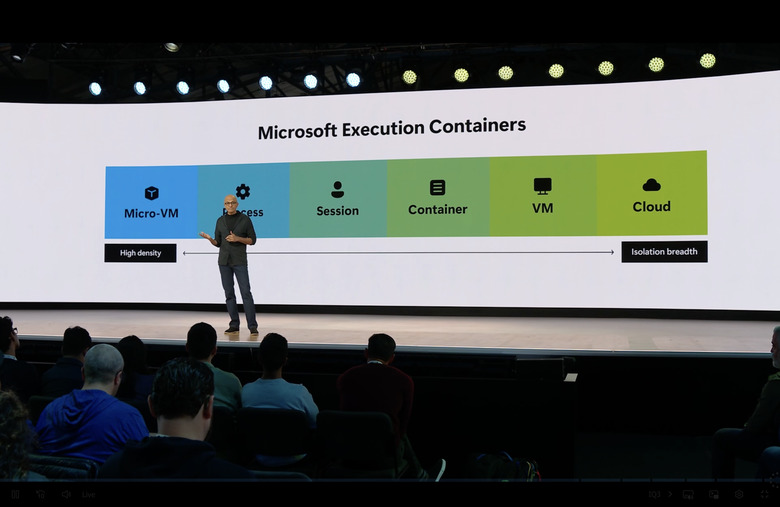
Satya Nadella presenting scintillating information about Microsoft Execution Containers.
-
Nadella calls Microsoft Execution Containers a new policy layer for keeping applications and agents, well, contained. That's one way to keep agents at bay, without access to the more critical aspects of your system.
-
Now we've got Scott Hanselman and Samantha Song on stage talking about how they use OpenClaw. Hanselman uses it to triage emails and buy movie tickets. Song is using it as a triathlon coach. They're showing off how OpenClaw can run in a Windows container, which looks a lot like a native Windows app.
-

Here's a preview of the app.
-

Song says Microsoft will give users "very granular" control of the files OpenClaw agents can access.
-
Song is asking OpenClaw to delete everything from his messy desktop. (Which looks a lot like my desktop, TBH.) OpenClaw can't actually delete those files, though, because its container is set to read only.
-
It's funny we have to build all of these restrictions for agents, almost as if they shouldn't be fully trusted.
-
Peter Steinberger, the "ClawFather" himself, hits the stage.
-

Here's said ClawFather.
-
"You can totally run OpenClaw inside your company now," he says. I can already hear the collective sigh from IT admins everywhere.
-
"My task is simple: Come build with us," he says.
-
Hanselman points out this was the first time we've seen OpenClaw running on a Surface Laptop Ultra.
-
We're moving away from Windows and to Microsoft Foundry in the cloud, and this is where my eyes start to glaze over.
-
Nadella is announcing a partnership with Fireworks AI to bring their models to Foundry, to "build the next generation of agentic applications."
-
Likewise, Dev. That said, I'm happy when there's greater access to open-weight models.
-
And we're onto GitHub itself: Nadella announces a new GitHub Copilot app.
-
He's announcing Rayfin, an agent-first SDK to connect your agents as a backend service.
-
Cassidy Williams, Senior Director of Developer Advocacy, hits the stage to talk about Rayfin and the GitHub Copilot app.
-

Here's a preview of the new GitHub Copilot app, which like Chrome has a hidden game.
-
Wonder what inspired that! (Google.)
-

Maybe the most fun someone has had during a Build demo.
-
This is indeed a fun demo! (I've moved to a standing desk to stay awake.)
-
Now we're talking about how to secure, govern and observe AI agents. (Just add "because they can't be trusted" to the end of everything Nadella says here.)
-
Amanda Foster, a Microsoft Product Manager, hits the stage to show off MS Foundry.
-

Developers just need to add the block of code you see below to deploy their agents through MS Foundry.
-
Foster claims MS Foundry can quickly make an agent enterprise ready, I'd love to know more about how that works.
-
Sarah Young, Director of Security, hits the stage to show how Microsoft's MDASH agentic security app works.
-

Young details a vulnerability Microsoft discovered with the help of this tool.
-
The Chainsmokers... are at Build? Didn't realize they had a portfolio and investment fund of their own.
-

If you're asking how they got into Build, it starts with sets they played at tech events in the mid 2010s, which got them started in angel investing.
-
I do seem to recall hearing them play while I liveblogged shows in the past.
-
Now Nadella is talking about the AI opportunity for companies, and not just developers.
-
He's talking about how Copilot has evolved for companies, starting with chatting, coworking and coding (with GitHub). He's now demanding that the audience clap for an upcoming Copilot "super app."
-
He's also announcing Autopilots, long-running autonomous agents. The first one is called Scout. Judging from a demo video, you can have it keep an eye on your inbox and Teamas sessions for things you need to do.
-

Here's a preview of said app, Scout. Or at least one of the first ones Microsoft is working on.
-
Mustafa Suleyman, the head of Microsoft AI, is now here talking about AI. I've listened to his audiobook, here is where i expect a lot of words that don't actually mean anything.
-

Indeed, here he is talking about Humanist Superintelligence. Suleyman says the core of Microsoft's superintelligence effort is to put humans first.
-
Suleyman announces seven new MS AI models across image, voice and transcription.
-

The first of those new systems is a new image generator that Suleyman says beats Google's Nano Banana.
-
The new image model is live in Powerpoint and coming to OneDrive soon. MAI-Transcribe-1.5 is a new transcription model that performs better than Gemini and OpenAI's.
-
Of the new transcription model, he says it's also the most efficient of any the ones offered by the major hyperscalers.
-
MAI-Thinking-1 is Microsoft's first text-based "reasoning" model, and it's powered by 35 billion parameters.
-
MAI-Code-1-Flash is a new efficient inferencing model, coming to VSCode today.
-
Suleyman says safety and security for these models is built in "from the start." That includes protections for voice cloning.
-
Suleyman is talking about Reinforcement Learning Environments, which are used to train AI models for specific purposes.
-

A single person loudly cheers when Suleyman claim that one of the new models offers 10x more efficiency than GPT-5.5.
-
Suleyman announces that Microsoft is working together with the Mayo Clinic for a new frontier model for health.
-
Gianrico Farrugia, the CEO of the Mayo Clinic, hits the stage to discuss how Mayo is working with Microsoft. "We each do what we do best, and we can tackle something that has eluded healthcare for some time: trusted and scalable solutions."
-
Tanaya Yadav, a Microsoft Senior Product Manager, is now discussing how frontier AI tuning works.
-
I feel like the hill climbing metaphor is going to get old fast.
-
20 minutes more of this keynote yall, hang in there..!
-
Gasp, Satya might be about to "close out" the whole thing?
-
Nadella says Microsoft Discovery, its AI platform for scientific research, has reached general availability. David Carmona, VP of MS Discovery and Quantum. is showing off how it works.
-

Here we get a demo of Discovery running. Carmona inputs three prompts into the platform.
-
Carmona says the tool can sometimes take hours and days to produce outputs because, like the scientific process itself, it doesn't necessarily work sequentially.
-
Carmona is also using Discovery to submit AI generated jobs to an automated lab. "It feels like being Iron Man, but for chemistry," he says.
-
Nadella says Microsoft is also making progress on building a scalable quantum computer. He's announcing Majorana 2, the sequel to last year's quantum computing chip, which used a new kind of superconductor.
-

Here's a closeup of that chip.
-
It offers a 20-second mean lifetime and 1 microsecond operations. I am deep into computers, but not quantum computers, so I have no clue what that means.
-
Nadella brings up the worst fears of AI: Technology concentrating power and reducing humanity. He claims Microsoft is trying to build an alternative. We'll see!
-
And with that, we're done. It does leave me wondering if we'll get to use quantum computers in our lifetimes.
-
Thanks for joining us, folks!
-
Phew, that was a marathon. Thanks for joining us for another liveblog.


